Manuka Wound Gels: Medical vs. Food Honey
Live PubMed feed • 4 min read
Medical Disclaimer: This page is for education. It is not medical advice, diagnosis or treatment. Talk to a qualified healthcare provider before using any honey product on a wound, especially a diabetic ulcer, a deep wound, or if your immune system is weakened.
Affiliate disclosure. The consumer honey section further down this page contains affiliate links. If you buy through them, this site earns a commission at no extra cost to you. Read our affiliate policy.
3 Key Facts
- Sterile vs. food honey: Honey made for wounds is processed to be sterile and sold as a medical product. Honey from a food jar is not sterile, and honey can carry Clostridium botulinum spores. Do not put food-jar honey on an open wound, and never give any honey to an infant under 12 months.
- The jar number is not a dose: We do not give MGO thresholds for wounds. We have not found trial evidence that sets one, and the right product depends on the wound. Your clinician chooses it.
- The evidence is limited: A Cochrane review of honey dressings (26 trials, 3,011 participants) rated most of the evidence as low or very low quality.
How Wound-Care Honey Differs From Food Honey
Honey sold for wounds is made as a medical device. It is processed to be sterile, usually by gamma irradiation, and it is sold with labeling and instructions for use. In the United States, honey-based wound dressings have been cleared through the FDA 510(k) pathway. Our regulation page explains the rules.
Food honey has none of this. It is not sterile, and a jar's MGO or UMF number describes the honey's chemistry, not its safety or its suitability for a wound. Wound-care products are standardized in different ways, so read each manufacturer's instructions and follow your clinician's advice.
If you are shopping for food honey, our MGO and UMF guide explains the labels.
How Honey May Work on a Wound
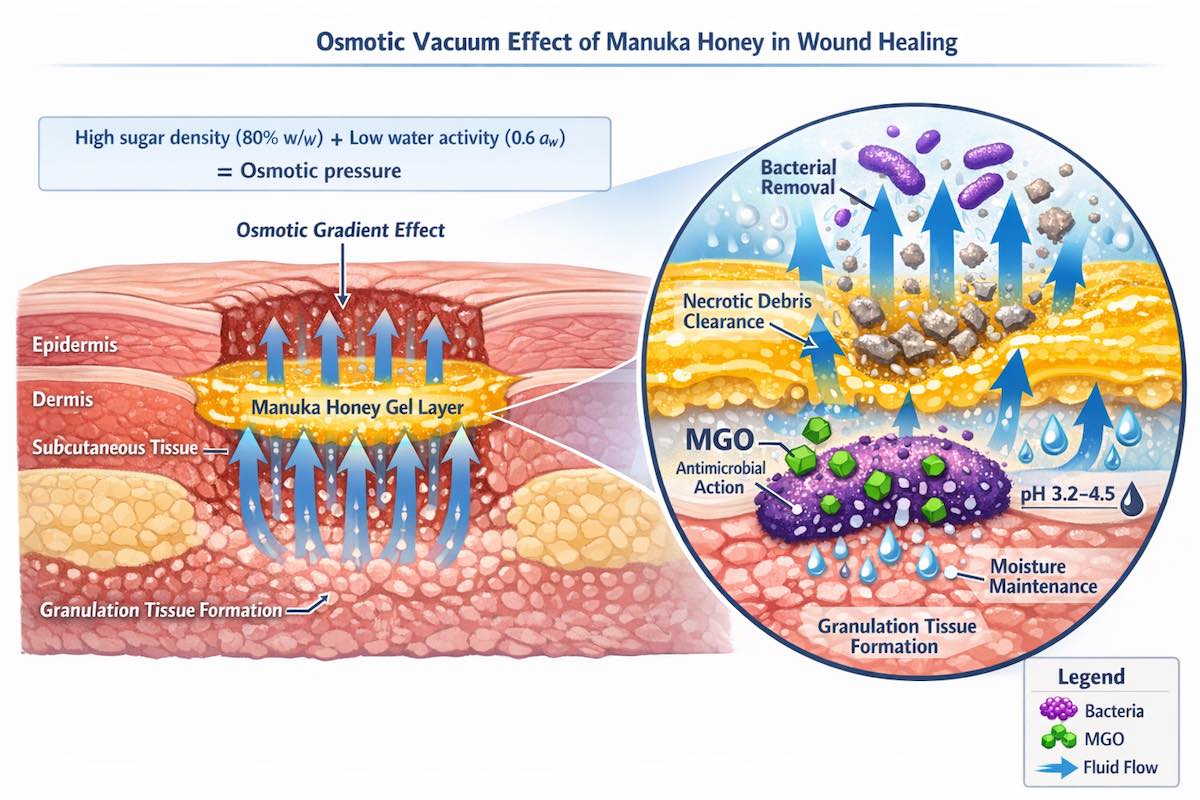
Honey is mostly sugar and has low water activity. That draws water away from bacteria and can create an osmotic gradient at the wound surface. Honey is also acidic, with a pH commonly reported between 3.2 and 4.5. Many honeys make hydrogen peroxide through an enzyme, and manuka honey also contains methylglyoxal (MGO), which shows antibacterial activity in laboratory studies. See our methylglyoxal science page for details.
Reviews describe other effects too, such as helping to clear dead tissue and keeping the wound bed moist. How much of this happens in a real patient is less certain. The Cochrane review rated most of the trial evidence as low or very low quality, and lab results do not predict clinical results.
Why not do it yourself: Honey products for wounds are made to a fixed formula and sterilized. Diluting honey or mixing it with other ingredients changes it, so follow the manufacturer's instructions.
What to Ask Your Care Team
Choosing a honey dressing is a clinical decision. Questions worth asking:
- Is a honey dressing right for this wound, and is there a reason I should avoid one, such as an allergy to honey or bee products?
- Which product do you recommend, and how often should it be changed?
- Which signs mean I should call you, such as spreading redness, more pain, swelling, pus or fever?
Source: Jull AB, Cullum N, Dumville JC, et al. Honey as a topical treatment for wounds. Cochrane Database of Systematic Reviews. 2015;(3):CD005083.
Live Research Integration
Latest peer-reviewed studies on Manuka honey wound care from PubMed. This feed updates automatically to surface new clinical evidence.
Important: Clinical vs. Consumer-Grade Products
The products featured below are food-grade honey for eating and everyday use. They are NOT sterile wound gels suitable for clinical wound management. For true medical-grade, gamma-irradiated Manuka honey gels, consult hospital supply vendors specializing in sterile wound care.
Consumer-Grade Manuka Honey Products
Products listed below are unsterilized consumer-grade honey. They are not equivalent to gamma-irradiated medical-grade wound gels and must not be applied to open wounds, surgical sites, or clinically managed ulcers. For sterile wound dressings, contact a hospital supply vendor specializing in regulated wound care products.
Affiliate disclosure. Every button in this table is an affiliate link. We earn a commission if you buy, and your price does not change. We list two brands because they run affiliate programs, not because they are the only good options. Prices were read from the retailer pages on October 15, 2026.
Consumer MGO Selection Resource
Ranked by labeled MGO. These are food-grade jars for eating and everyday use, not wound care.
| Product | MGO Rating | Consumer Tier | Primary Use Case | Price | Source |
|---|---|---|---|---|---|
| Raw Monofloral Mānuka MGO 1100+ Wedderspoon | 1100+ | Elevated Potency | Very high labeled MGO. Food-grade honey for eating and everyday skin care, not for open wounds. | $124.99 | Check price at Wedderspoon |
| Raw Mānuka Honey MGO 850+ Wedderspoon | 850+ | Elevated Potency | High labeled MGO. Food-grade honey, not sterile and not for open wounds. | From $79.99 | Check price at Wedderspoon |
| Raw Monofloral Mānuka MGO 400+ Wedderspoon | 400+ | Moderate Potency | Moderate labeled MGO. Food-grade honey for eating and everyday use. | $41.99 | Check price at Wedderspoon |
| Manuka Honey Extra MGO 600+ Manuka Health | 600+ | Moderate Potency | Labeled MGO 600+ from Manuka Health, positioned by the brand for dietary use. Not sterile. | $75.00 | Check price at Manuka Health |
| Raw Monofloral Mānuka MGO 150+ Wedderspoon | 150+ | Entry Potency | Entry-level monofloral jar for general dietary use, with the lowest labeled MGO of the monofloral options here. | From $27.99 | Check price at Wedderspoon |
| Raw Multifloral Mānuka MGO 50+ Wedderspoon | 50+ | Baseline | Multifloral blend with a low labeled MGO. Food-grade honey for eating and cooking. | $14.99 | Check price at Wedderspoon |
Want to compare more jars? See 13 Manuka honey jars ranked by price per 100 g, or read the plain-English MGO and UMF guide.
How we earn money: Links in the consumer honey table are affiliate links, and we earn a commission on qualifying purchases. We compare published labels and retailer pages. We do not lab-test any product. See our affiliate policy for full details.